
Cooking at home is supposed to save money. It doesn't always feel that way, especially on a weeknight when the idea of chopping four onions by hand sounds worse than just ordering in. The ten tools below won't fix that entirely, but the right ones seem to close the gap between "should be cheaper" and "actually is cheaper" more than most people expect going in.
Why This Is Really A Money Question
Kitchen gadgets tend to get marketed on convenience, which is fair enough as far as it goes. But the more interesting case for most of them is financial, and it rarely makes it onto the box. A slow cooker uses a fraction of the electricity an oven does. A garlic press needs no electricity at all. Neither fact shows up in the marketing copy, though arguably it should.
The list below wasn't built around novelty. It's built around whether a gadget tends to stay on the counter or quietly migrates to the back of a drawer within a month, which is really the only test that matters.
1. Slow Cooker — Best Overall Pick
Best for: busy households, meal preppers, and anyone trying to make a cheaper cut of meat taste like it wasn't.
A slow cooker runs on comparatively little electricity next to a conventional oven, which matters more than it sounds like it should once it's running most days of the week. Ingredients go in during the morning; a finished meal is waiting by evening, with minimal supervision required in between. The bigger win might be what it does to inexpensive cuts of meat — several hours at a low temperature can turn something tough and cheap into something that tastes like neither.
Budget-friendly: 5/5 · Time-saver: 5/5
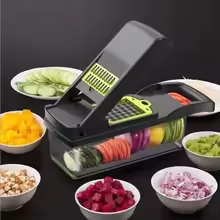
2. Vegetable Chopper — Best Time-Saving Gadget
Best for: anyone who cooks fresh vegetables often enough that chopping starts to feel like a chore.
One press dices onions, peppers, tomatoes, and cucumbers into pieces uniform enough that a knife rarely manages on a rushed weeknight. The time saved per meal is modest — a few minutes, maybe — but it compounds fast once you're batch-cooking for the week instead of just one dinner. Easy to clean, too, which matters more than most reviews mention, since a gadget that's a hassle to wash tends to get used less regardless of how well it chops.
Budget-friendly: 5/5 · Time-saver: 5/5
3. Reusable Silicone Cake Cases — Best Money Saver
Best for: home bakers tired of restocking disposable liners every few months.
Disposable baking liners look cheap individually, and technically they are, but the cost adds up in a way that's easy to ignore purchase by purchase. A set of silicone cases might run somewhere around $3, reusable for hundreds of bakes, dishwasher safe, non-stick enough that results don't noticeably suffer compared to the throwaway version, and there's less landfill involved too, for whoever that factors into the decision for. Small upfront cost against a recurring one — the kind of trade that's obviously worth it once someone actually points it out.
Budget-friendly: 5/5 · Time-saver: 3/5
4. Rapid Egg Cooker — Best Breakfast Gadget
Best for: mornings that don't have room for standing over a pot.
Eggs cooked in around six minutes, with an automatic shut-off that means nobody has to hover nearby watching a timer. Results come out consistent in a way that stovetop boiling, with its many small variables, tends not to. Cleanup is minimal too, which for a breakfast gadget is arguably the deciding factor more than the six minutes is.
Budget-friendly: 4/5 · Time-saver: 5/5
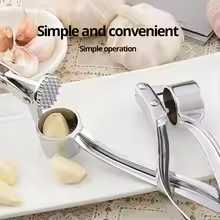
5. Garlic Press — Best Everyday Cooking Tool
Best for: anyone who cooks with garlic often enough to be tired of mincing it by hand.
Fresh garlic does something to a dish that the jarred, pre-minced version mostly doesn't, but mincing it by hand is genuinely tedious. A decent press crushes a whole clove in one motion, comfortable enough in the hand that repeated use doesn't start to hurt after a few weeks, and rinses clean in seconds. Not a complicated tool, and that's sort of the appeal — it does one thing and does it well.
Budget-friendly: 5/5 · Time-saver: 4/5
6. Hand Blender — Best Multi-Purpose Gadget
Best for: small kitchens, and anyone who'd rather not haul out a full blender for a pot of soup.
Blending happens directly in the pot instead of transferring hot liquid into a separate container, which cuts down on both mess and dishes considerably. It's also, somewhat underrated, a decent way to deal with vegetables that are past their best — a few bendy carrots or a softening potato that would otherwise get thrown out can become a passable soup instead of landfill. Smoothies, sauces, baby food — the range is wider than the compact size suggests, and storage takes up almost no drawer space.
Budget-friendly: 4/5 · Time-saver: 5/5
7. Stackable Food Containers — Best for Meal Prep
Best for: meal preppers and anyone tired of buying foil and cling film on a loop.
Reusable containers replace a recurring expense — foil, plastic wrap, both bought again and again — with something that pays for itself after a handful of uses. They stack efficiently enough that cupboard space stops being a real issue, most go safely from freezer to microwave, and portioning leftovers or a batch-cooked meal into ready-to-eat servings extends how long the food actually stays good. That quietly cuts down on both waste and last-minute takeout orders. Dedicated freezing trays, something like Souper Cubes, take this a step further by freezing soups or sauces into evenly portioned blocks instead of one solid, awkward mass.
Budget-friendly: 5/5 · Time-saver: 4/5

8. Mini Food Processor — Best Compact Prep Tool
Best for: small households and quick weeknight cooking.
Chopping onions, blending herbs, grinding nuts, pulling together a homemade pesto or a spice blend that would otherwise mean buying several separate jars — a mini processor handles most of it in seconds and stores easily in a drawer, unlike its full-sized counterpart. One use that doesn't get mentioned often: turning the heel of a bread loaf into breadcrumbs instead of tossing it, then freezing what's left for later. A small habit, but it adds up over a year.
Budget-friendly: 4/5 · Time-saver: 5/5
9. Salad Spinner — Best for Fresh Produce
Best for: anyone who skips salad because washing and drying lettuce feels like more effort than it's worth.
Centrifugal force does the work here, pulling excess water off washed greens fast enough that they stay crisp rather than turning soggy in the fridge two days later. That extra shelf life means less produce gets thrown out and fewer trips back to the store to replace wilted greens. Simple to operate, and the payoff seems bigger than the size of the gadget would suggest.
Budget-friendly: 4/5 · Time-saver: 4/5
10. Mandoline Slicer — Best for Fast Vegetable Prep
Best for: anyone who slices a lot of potatoes, cucumbers, onions, or carrots and is tired of doing it by hand.
Adjustable blades produce slices, julienne cuts, and thin shreds more evenly and considerably faster than a knife manages, whether it's vegetables or firmer fruit, especially across a large batch. Worth being careful with — mandolines have a reputation for a reason — but for anyone cooking in volume, the time saved is hard to argue against.
Budget-friendly: 4/5 · Time-saver: 5/5

Where The Actual Savings Show Up
The time savings are the easier sell. The money savings take a little more explaining, but they're arguably the more convincing part of the case for any of this.
Energy costs drop first. A slow cooker uses meaningfully less electricity than an oven running for a comparable stretch of time, and manual tools — a garlic press, a pestle and mortar instead of an electric grinder — use none at all. Cookware matters here too, in a way that's easy to overlook: stainless steel with an aluminum core conducts heat more evenly, which means less energy wasted heating a pan unevenly before the actual cooking even starts.
Food waste is where a surprising share of the savings hides. A salad spinner keeps greens from turning to mush in the crisper drawer. A hand blender turns vegetables that are a day or two past their best into soup instead of the bin. A mini processor can turn the heel of a loaf into breadcrumbs worth freezing rather than tossing out.
Then there's the convenience-food math, which tends to be the largest number of the three. A daily coffee shop habit — two cups most days — can run somewhere around $140 a month, give or take, and a home coffee machine erases most of that fairly quickly. Homemade bread might cost something like 50 cents a loaf once a bread machine's involved, against several dollars for a comparable loaf at the store. None of this requires giving anything up; it mostly just moves the same habit somewhere cheaper.
Recurring consumables round it out. Reusable silicone cases replace disposable baking liners. Stackable containers replace box after box of foil and cling film. None of these savings look dramatic on their own. Add them up over a year, and they tend to come out larger than people expect going in.
Common Mistakes
Buying something bulky that looked useful in a video and rarely gets touched afterward. Not measuring the drawer or counter space before ordering, which is how a mandoline ends up living in a box in the garage. Choosing a single-purpose tool over something more versatile, when the versatile option usually costs about the same. Picking the cheapest version of something without checking whether it survives six months of regular use. And skipping anything explicitly aimed at reducing food waste, which is often where the real long-term savings were hiding the whole time.
Frequently Asked Questions
A vegetable chopper, probably by the widest margin. It turns several minutes of chopping into something closer to seconds.
A slow cooker. Lower energy use, simpler meal prep, and it makes inexpensive cuts of meat taste like they weren't inexpensive.
A salad spinner, a hand blender, and stackable food containers all do real work here, each in a slightly different way — keeping produce fresh longer, using up vegetables before they spoil, and storing leftovers so they actually get eaten instead of forgotten.
Not always. A fair number of tools under $100 perform close enough to their pricier counterparts that the extra spend doesn't obviously buy much for everyday cooking.
Our Actual Pick
Starting from nothing, five gadgets probably cover most of what a kitchen actually needs: a slow cooker, a vegetable chopper, a hand blender, a set of stackable containers, and a mini food processor. Together they handle meal prep, everyday cooking, and leftovers without much overlap between them.
Once those are in place, a mandoline slicer, a rapid egg cooker, and a salad spinner are reasonable next additions — not essential, but each one tends to earn its spot fairly quickly once it's actually in rotation.
None of this requires a kitchen renovation or much of an upfront spend. It mostly comes down to choosing tools that get used often enough to matter, instead of ones that looked good in a two-minute video and then sat in a drawer.
Browse more guides like this on the Lookbook.